A new creative development opportunity from
Birds of Paradise and Bijli Productions
[toggle title_open=”Page Navigation” title_closed=”Page Navigation”]
Click on the below section headers to jump to that section.
[/toggle]
What is Bolster?
Bolster is a creative development opportunity from Birds of Paradise (BOP) and Bijli Productions that offers artists who identify as disabled and as a person of colour or from a mixed heritage (more information here), the chance to develop a new creative idea or continue working on an existing creative idea that has not been fully realised yet.
BOP and Bijli are excited to collaborate on Bolster. The aim of this collaboration is to provide an opportunity that is designed for the specific communities that each of our organisations specialise in working with, and to create a supportive environment for artists who may have experienced barriers in previous development opportunities.
BOP knows that for disabled artists, development opportunities that do not successfully support access requirements can stifle creativity before it has begun, let alone let you find the creative conditions to push in a new direction.
Bijli focuses on developing artistic practice and self-expression in underrepresented communities, by providing opportunities to support the creative agency of artists from ethnically diverse backgrounds. Bolster will provide the space for you to do that.
Making work involves a lot of hard work and finding the time, space and resources to do this can be a challenge. BOP and Bijli are creating this opportunity so that artists who experience barriers or exclusion can have time to think, research, experiment and develop their ideas, with the knowledge they are being paid for their time and are in a supportive environment with access to the knowledge of both companies.
What does Bolster involve?
Bolster consists of two strands:
A) Early Stage Development
The Early Stage Development strand is intended for artists/ collectives who have the seed of a creative idea in their mind, and need some dedicated time to explore that idea and work out how best to make it grow.
B) Continuing Development
The Continuing Development strand is intended for artists/ collectives who have already done the early stage thinking around an idea. They have a specific direction they want to take the idea in and need some dedicated time to achieve that.
Meet the artists
Hannah Yayha Hassan
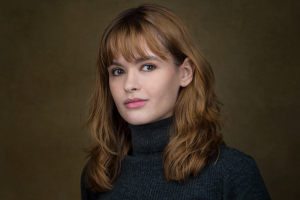
Hannah Yahya Hassan is a Glasgow based Scottish/Bahraini actress and writer. She has worked with multiple theatre companies including: Ramps on The Moon, Graeae, National Theatre of Scotland and Scottish Youth Theatre. Her recent touring credits include Fault Lines (2020) and Act of Repair (2019). She has toured in both Scotland and England and is particularly drawn to any work that explores the intersections of minority identities.
Project: Continuing Development
How to Ride a Bike (and Other Things Baba Taught Me)
A play explores and celebrates neurodiversity in Arab/Muslim cultures through a father daughter relationship.
[toggle title_open=”What Hannah worked on for Bolster” title_closed=”What Hannah worked on for Bolster”]
I used my time on Bolster to develop the play that I began working on at the beginning of 2021. The current iteration of this play is called ‘How to Ride a Bike (and Other Things Baba Taught Me). It is a piece that tries to work against the dangerous controlling stereotype that we see of Arab and Muslim men in the arts in the west. It does this by exploring a father daughter relationship through the hazy rose-tinted memories of a woman’s childhood.
I began writing it last year and in September 2021, I was lucky enough to receive funding from The National Theatre of Scotland to develop it further. I did a small three-day R&D. My team consisted of: Firas Ibrahim to play the Baba character, Nat McCleary as movement director, Sara Shaarawi as dramaturg and myself as an actor, writer, director and lead artist. It was during this R&D that I envisioned what my next step should be and Bolster helped me achieve that. I knew that this time round I wanted more time and more people in the room. I wanted to play with new scene ideas and explore the physical journey of the bike metaphor that we began to look at last year.
A week in the room followed by a week of writing was the perfect amount of time to do this. With regards to more people in the room, this time round I wanted a director, as I felt myself having to wear too many different heads in the first R&D. After speaking to a few different candidates, I entrusted Edinburgh based director Jen McGregor with the role. I knew I desperately needed a director but as anyone would be, I was apprehensive putting this project, that is very much a passion project and my baby in someone else’s hands. And yet, I am so glad I did. I feel Jen greatly enriched the process and handled what is foreign subject matter to most in Scotland with gentleness and curiosity. I used some of the budget to meet beforehand to really explain the bones that this project was carved out of and how I like to work. I feel that this time was really valuable and made all the difference, as it meant very little time was wasted in the rehearsal room trying to understand what this piece was striving for and how I felt about certain things as the writer and lead artist.
The time in the space was invaluable and we managed to establish a great sense of play in the room, which is integral to the piece. I left the first week of R&D with a much clearer idea of the plays entire journey. How it begins, how it ends and everything in between. It made the following week of writing flow remarkably easily. I have managed to double what I had originally written and have a clear idea of what needs to be explored in the next stage of development: Code-Switching in bilingual families and third culture kids.
The process as a whole was beneficial to my practice because it helped teach me, that just because it is my practice, does not mean that I have to try to do everything myself. If I want to hire someone to take care of the admin, I should hire someone to take care of the admin, because your value as an artist is not placed on your ability to chase people up and send repeated emails. We are berated with hustle culture so much that we forget that we do not need to do everyone’s job. We can carve out our boundaries and work within them and that does not make anyone less than.
[/toggle]
Myla Corvidae
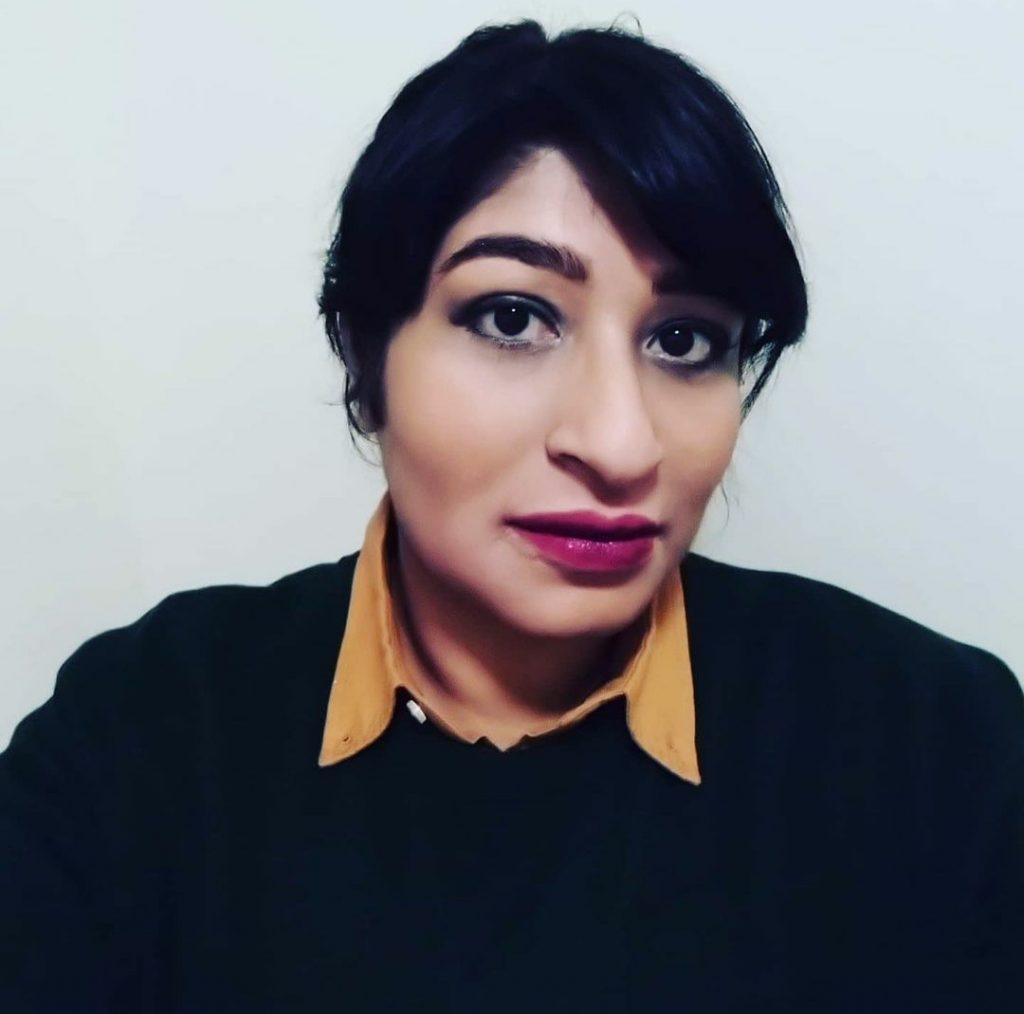
Myla is an up-and-coming multi-disciplinary artist, writer and performer working and living in Scotland. They have worked extensively with Queer Heritage Forum, The Pandora Men Youtube series and Scottish BIPOC Network. Myla is currently working in story illustration with Gwyllion Magazine and creating games with Corvidae Games.
Project: Early Stage Development
Living With All of Me
Artistic responses to living with Dissociative Identity Disorder and ADHD.
[toggle title_open=”What Myla worked on for Bolster” title_closed=”What Myla worked on for Bolster”]
Terms used in the blog:
Alt – A single personality in the Dissociative Identity Disorder (DID) system – speaking from one perspective.
Collective – Speaking as a cohesive whole, as an entire system rather than separately.
I have always been bad at finishing projects, coming to the end of a chapter and then finding my next steps. I am unwilling, in some sense to let go of this period of time and development, simply because it was so rewarding.
The fear of faltering is something everyone is familiar with in some way or another and having the Bolster grant has given me the space to face that fear and develop this piece of work I set out to do.
I have been very unwell throughout this process but it was always going to be an uphill battle to create in the face of disabilities, coupled with suddenly appearing kidney issues I had a very limited timeframe in which to produce something. It was also my first stumbling block.
I went into this process determined to create and complete a finished piece which as a game around DID (dissociative identity disorder) and bringing awareness to the struggles and joys of living as more than one person. My entire focus was on creating a game as an end process, to be “productive” however after speaking to members of the community I realised I was approaching this in the wrong way. The advice I received was that I shouldn’t be trying to speak for a diverse community because anything I try and create will have issues, will fall under criticism and ultimately won’t be the intended end product. Therefore I decided to change the perspective and focus of the future game, where I would be speaking entirely from my own experience and perspective.
This was a real turning point for me because my development of a game effectively was put on hold until I found the path I wanted to go along with sharing my story. How do you put yourself into something so visceral and open? I’ve always translated myself in pieces and I was wondering how I could form a cohesive story about how I wanted to tell people about “us”.
the narrative here switches as speaking from a collective rather than just one alt view so we refer to ourselves/we/us.
In the end we defaulted to our strongest cultural ties, where do those lines lead and how does it intersect. The grant enabled us to explore these possibilities without begrudging pennies and thinking about the cost of exploration within this dynamic of self.
We settled on collaborating with the four parts of our system that are creative in a drawing and writing format and see where we led each other. Through allowing for that looser progress style we discovered something wondering, the weaving narratives between us that lead to an idea of something we could follow through with.
The end idea is creating a game based around DID but with a cultural aspect connecting this to ourselves. The main themes that came up between us was specifically embroidery/fabrics and the body as a physical presence. Specifically interconnecting Islamic geometric patterns and the everyday, which will be visible throughout the end result of the game in the form of fracturing.
You can see from the four pieces of art we made together that there’s different stories that each part wanted to raise and discuss.
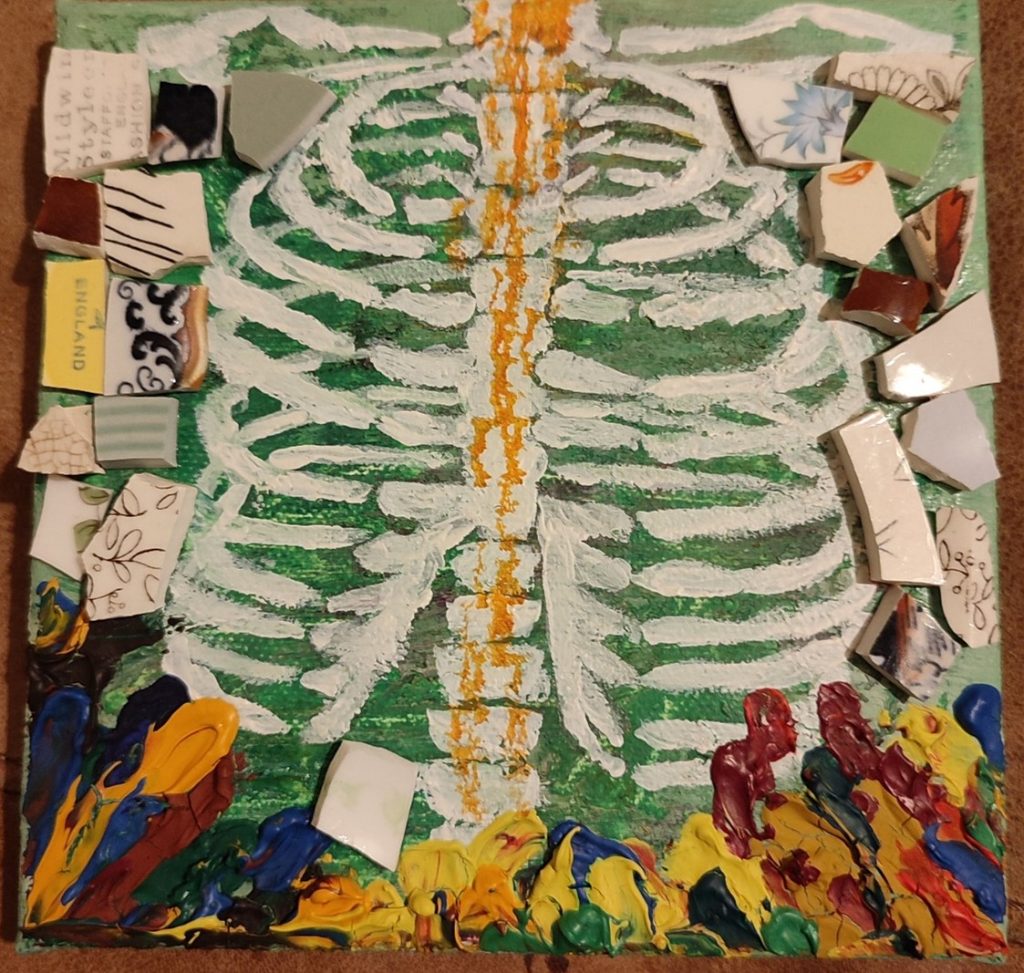
This one is referencing the pain of disconnection and separation, where a body becomes parts and fractured, we used the idea of china/porcelain being shattered around us and still having this colourful viewpoint on everything. It’s in reference to the constant of pain and beauty being intermingled in our growth. We touched on the creation of mosaic in this piece.
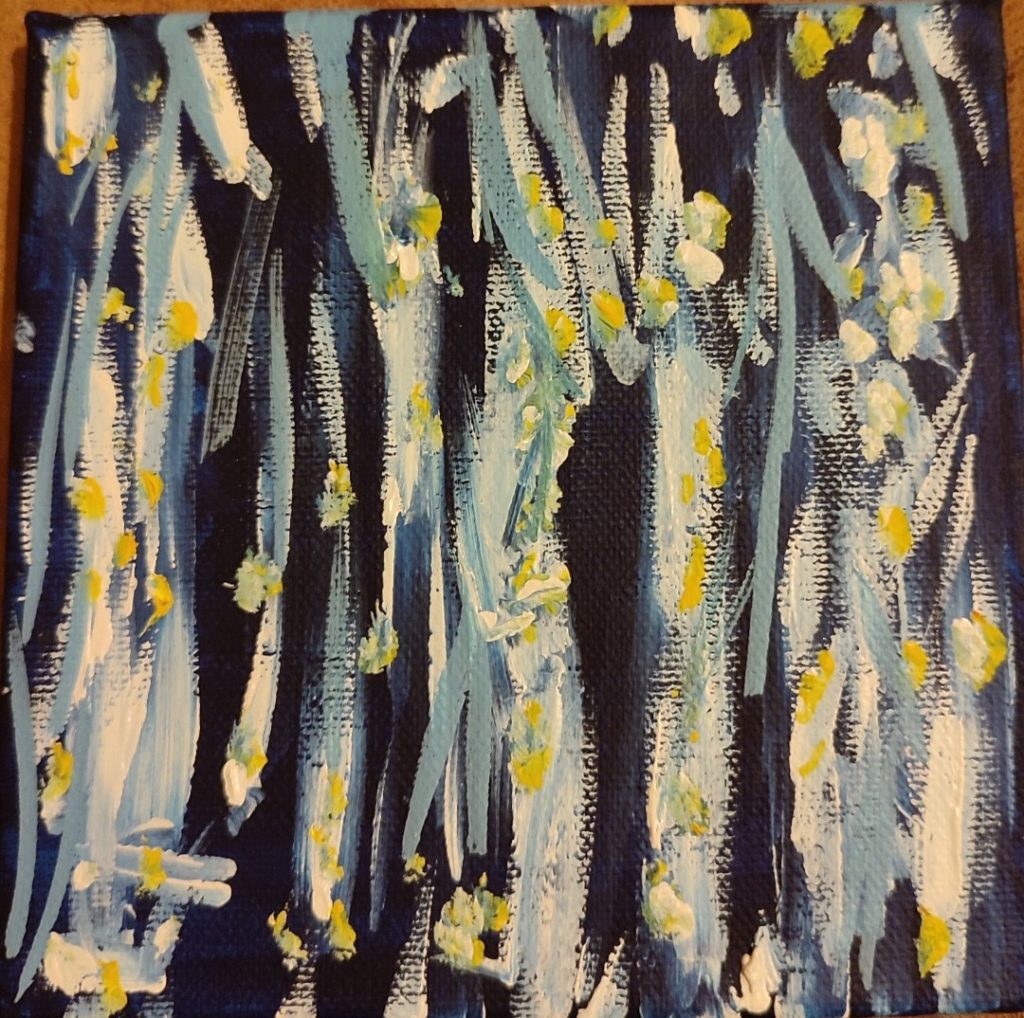
This one is discussing the issues of visual and auditory hallucinations that occur when we switch between parts and navigating that can feel like seeing through bars, like the world outside doesn’t make as much sense as the inside. It’s also discussing the distractions from internal voices and the impact that has on our outward presenting “self”.
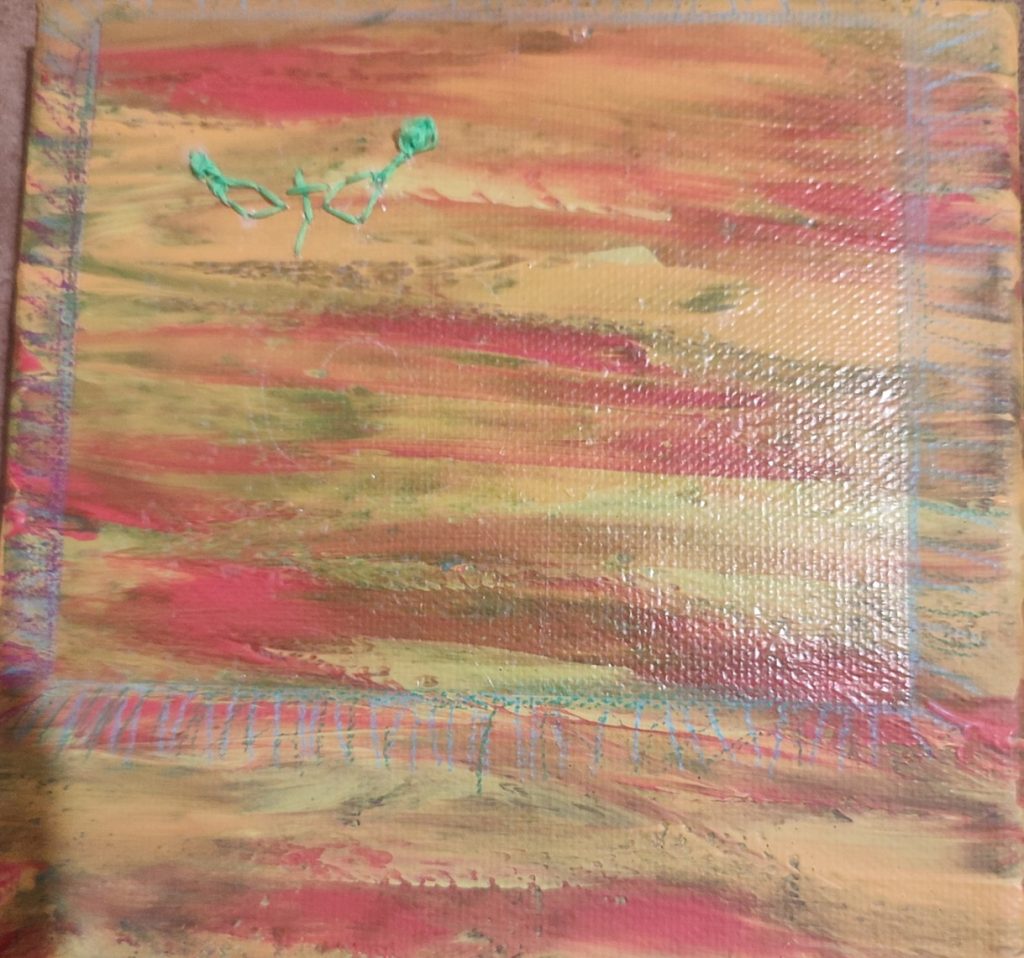
This one is probably the most interesting one we have produced in our plans for building a game it was highlighted that we cannot ignore the impact that displacement/ migration has had on us. The image is of a “missing” rug, referencing our Afghani heritage being removed from us, not being able to connect to a culture that we are strongly tied to. The eyes stitched to the missing rug is around the concept of being watched and “observed” as a dangerous person because of the colour of our skin and our mental health disorders which make us a collective rather than a single person.
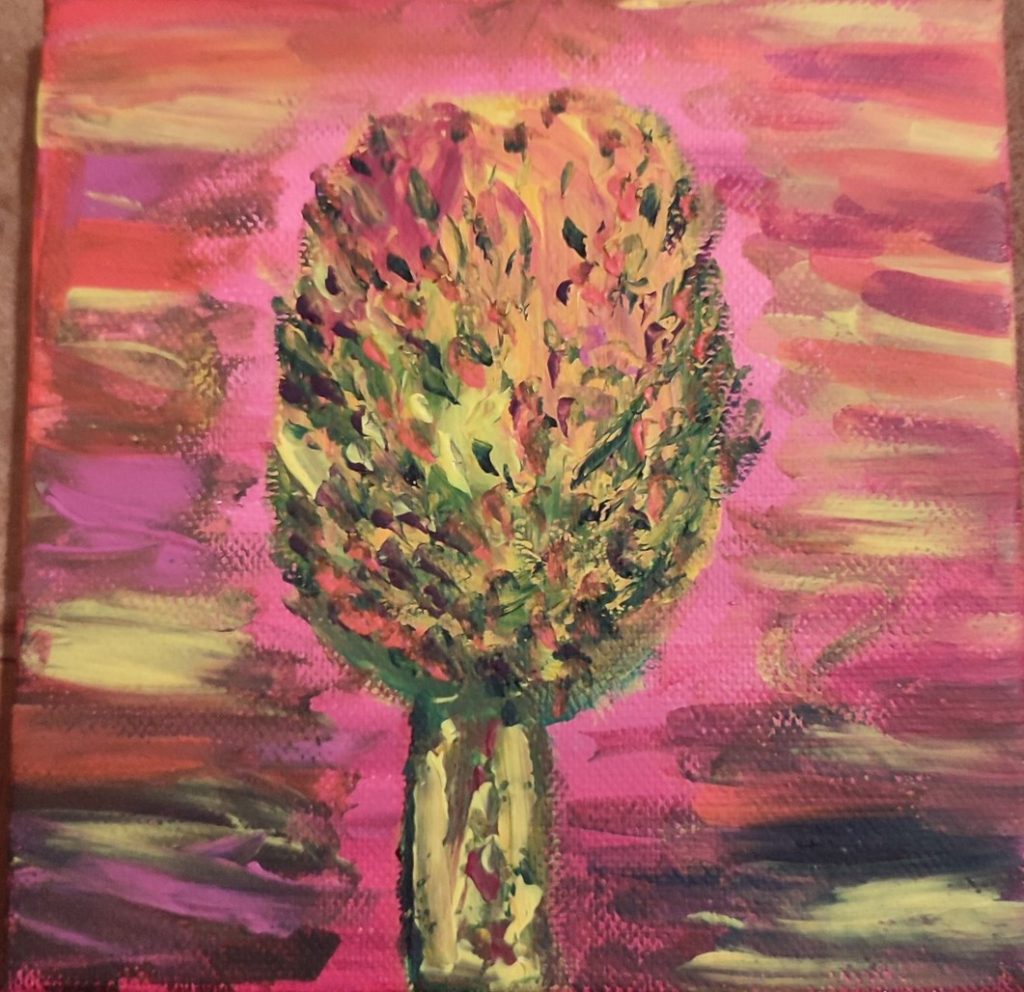
This one is about nature, and how beautiful it is but also how dangerous for us it is to be there. Further out of cities spaces are not diverse and feel unsafe for us to occupy. So it’s talking about the beauty of Scotland but the fear around enjoying the space entirely without a care for the other people there.
So these are where we started off, the way our system communicated to us that it’s where they would like to start.
The other side of our research was the body and ownership of it. We tried to take photographs of ourselves that were pieces similar to the way we see ourselves as something other. We produced a photographic print of our body that is both a nude and showing nothing typically considered sexualised, which was then shown at IMT Gallery in London within the Naturally Non-Binary Exhibition. This was talking about the sexualisation of self, the lack of self-acceptance and process in the ways that we exist in line with nature.
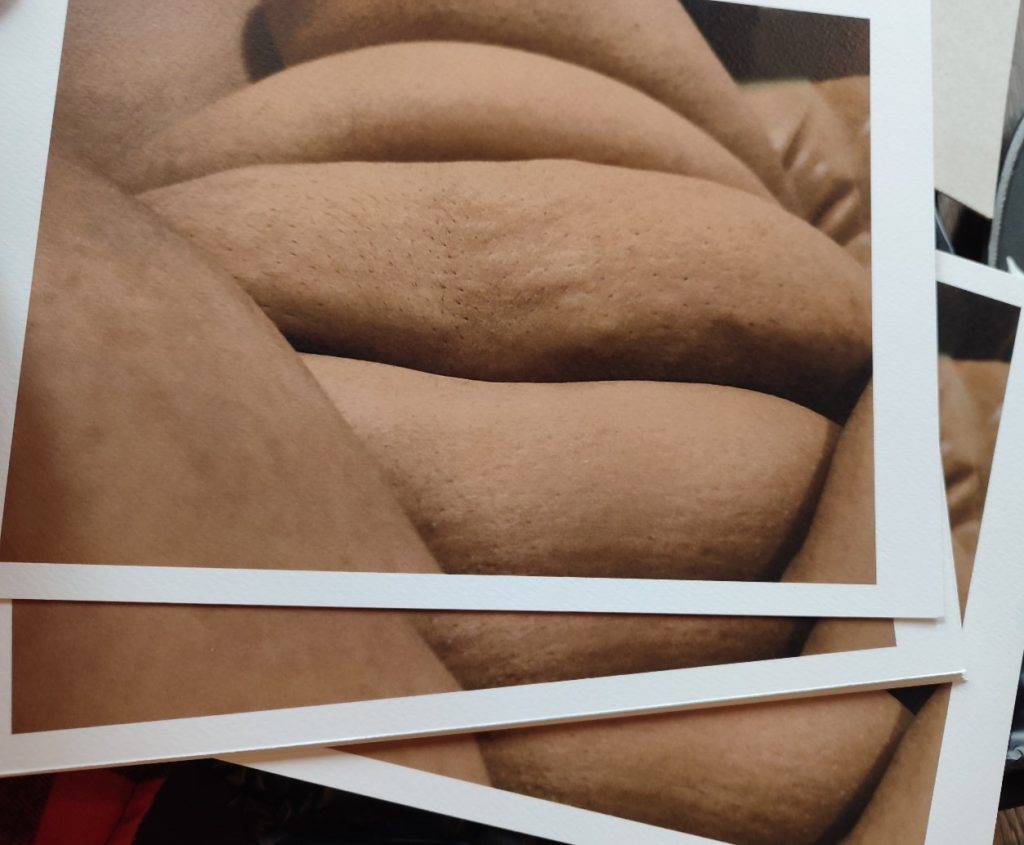
The body as a landscape, peaks and valleys, a body in the exploration of existence.
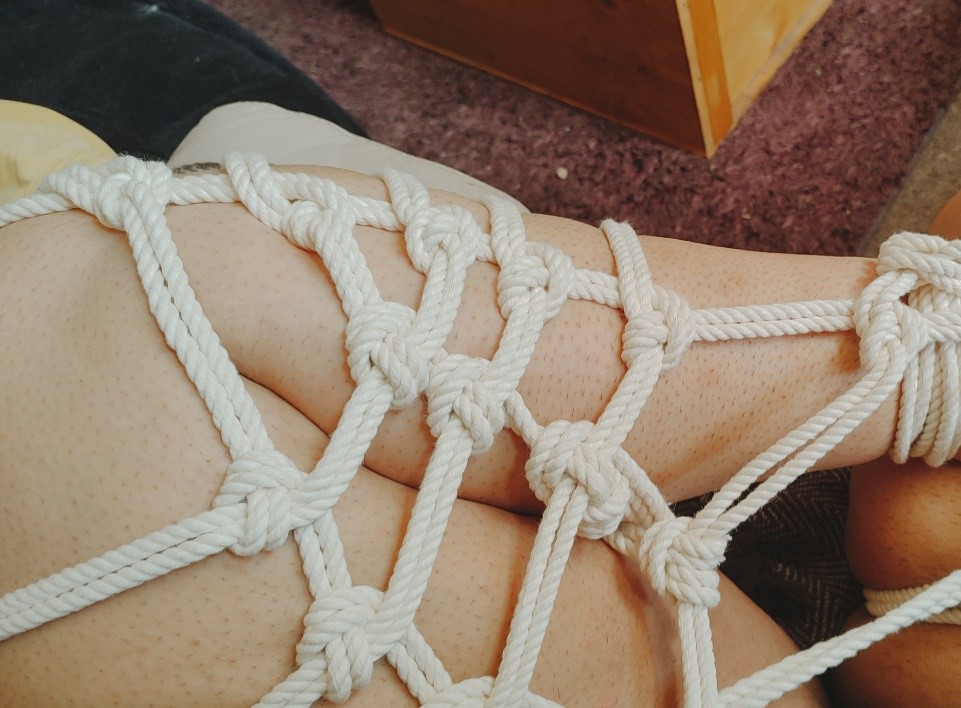
The body as a form of architecture, building triangles to hold weight of objects and containing ourselves.
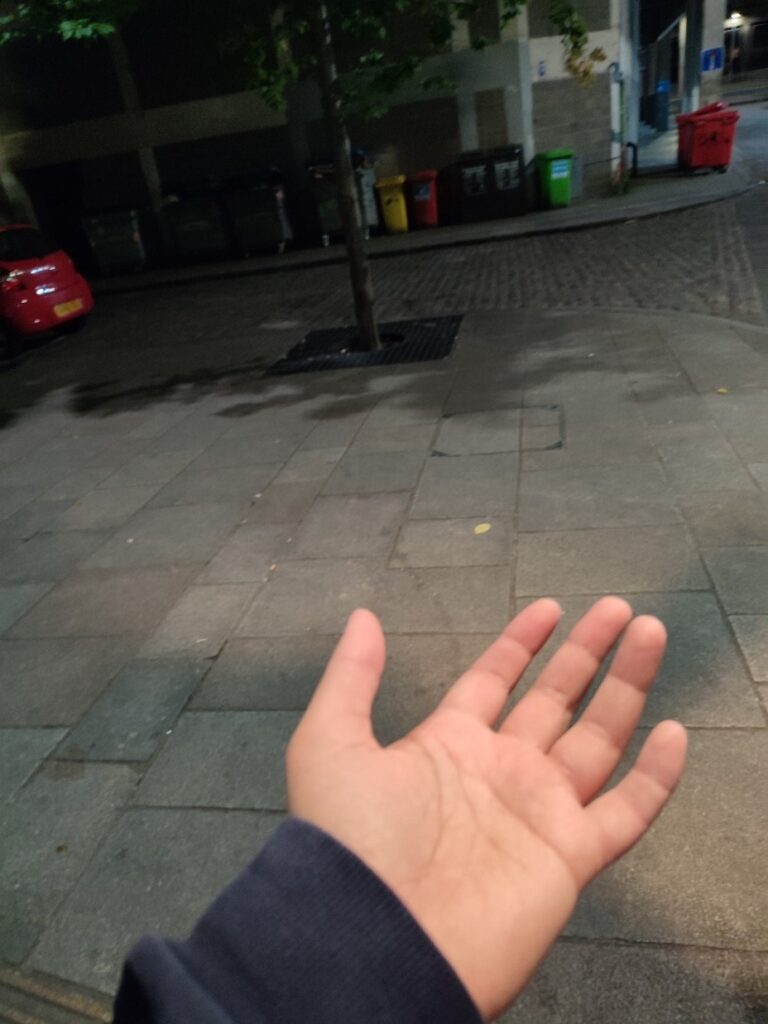
Shadows and light play with the idea of power – light in one hands fending the darkness of regressive memories/PTSD.
the narrative here switches as speaking from one alt view rather than collective so the references to self becomes I/my.
I have continued this series with taking images of our bodies, of nature and how they overlap in the way we see the world.
Lastly I looked at and investigated embroidery and crochet, creating possible ideas such as an entirely stitched zine from found fabrics and pieces of stories from all our parts, where they are able to create their own narrative through it. Unfortunately, that progress was halted due to disabilities affecting our creative process, however I look forward to completing that idea as part of my future planning and progress.
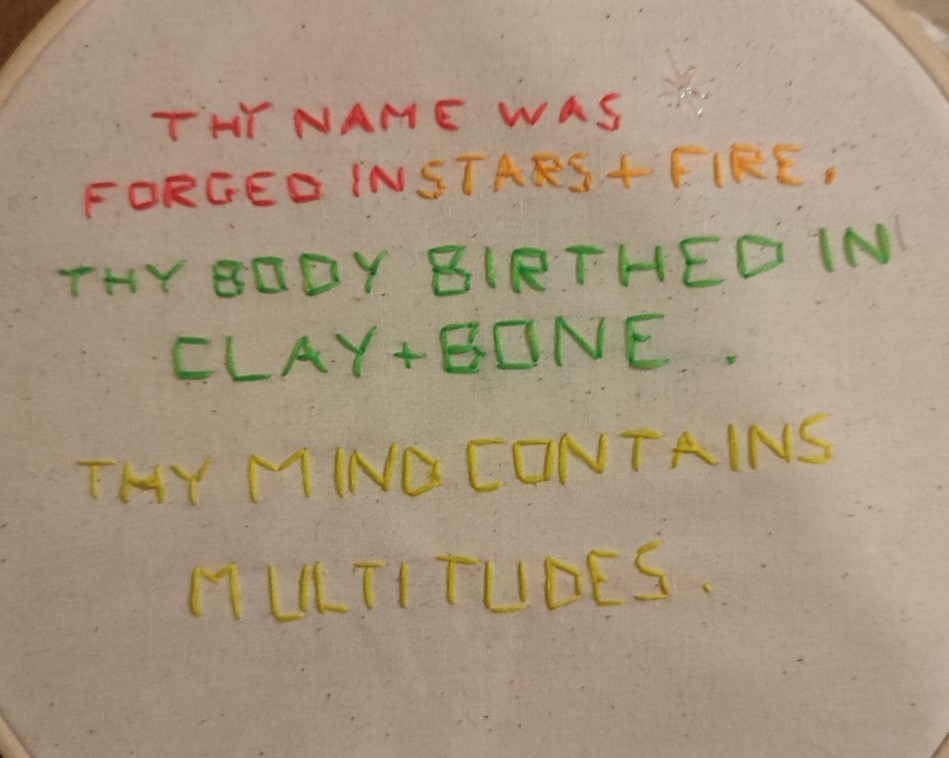
Neon thread on off white muslin fabric: “Thy name as forged in stars and fire. They body birthed in clay and bone. Thy mind contains multitudes.”
I think the final game idea will be a combination of poetry, stories, pieces of writing, and a narrative threading everything together at the end. Where you, yourself, piece together a sense of self with me and hopefully gain a sense of what it’s like to live with DID.
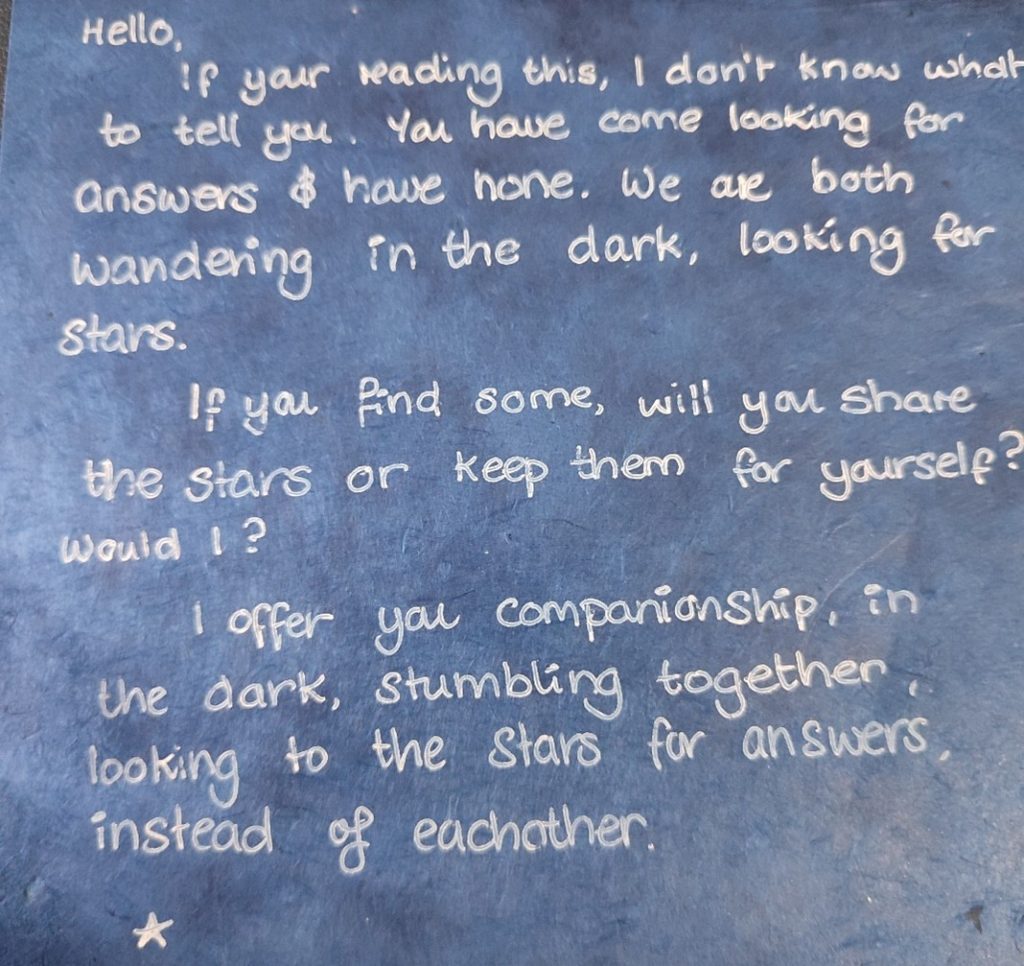
Blue paper with writing: “Hello, if your reading this, I don’t know what to tell you. You have come looking for answers and have one. We are both wandering in the dark, looking for stars. If you find some, will you share the stars or keep them for yourself? Would I? I offer you companionship, in the dark, stumbling together, looking to the stars for answers, instead of each other.”
[/toggle]
Yoonett
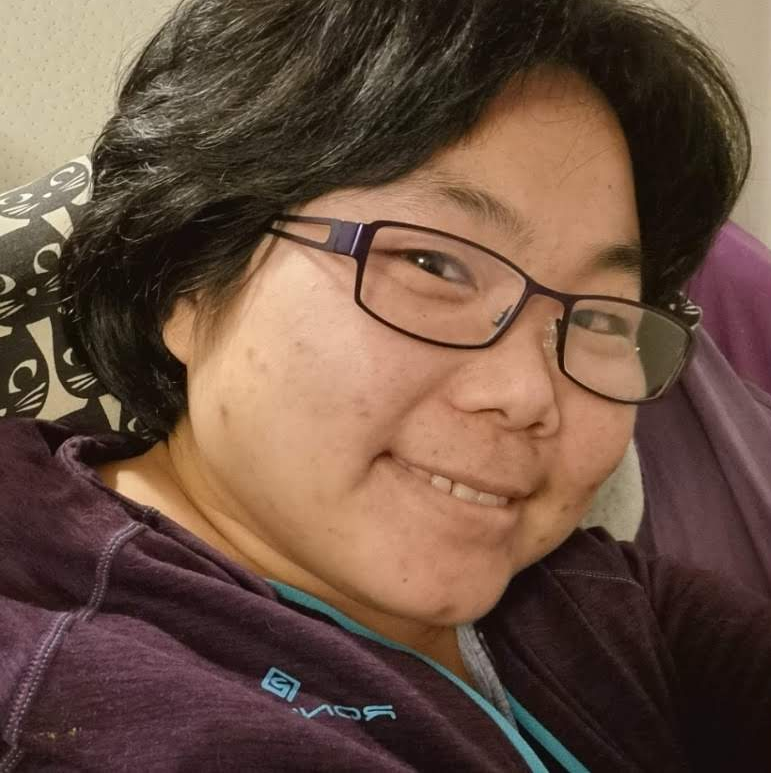
Yoonett is the artist’s persona of Christina Soo Ja Massey a Korean born international adoptee of German Nationality and upbringing. Yoonett is a versatile artist, who derives inspiration from the interplay of personal trauma, cultural turmoil and identity search. Never quite fitting in and feeling incomplete. But believes that the beauty in life can bring out the beauty in people.
The previous career includes a BA Hon and Diploma in Social Work, a certificate in Social Project Management, social care work, workshops and project work and other volunteer work in a variety of work settings.
Since 2016 producing Yoonett Arts has become a focus and vocation. Contributing to exhibitions and organising own exhibitions of Yoonett Artwork. Taking part in Artist collaboration, networks and workshops, as well as organising own workshops and events. Also working as an Artist at Project Ability in Reconnect a group of artists with mental health disabilities.
Yoonett Arts has a social media presence on platforms like Facebook, Instagram, Twitter, DeviantArt and YouTube.
Project: Early Stage Development
Überlebenskünstlerin – Artist of Survival
A play exploring international adoption, mental health and suicide, from the perspective of a Korean Overseas Adoptee.
[toggle title_open=”What Yoonett worked on for Bolster” title_closed=”What Yoonett worked on for Bolster”]
Artist of Survival – a creative script writing project.
I am not a Writer and never have been. I thought.
Being a self-proclaimed Artist, I have tried many different areas of art.
But the areas of writing and performance have stayed undiscovered and unexplored to me.
The project was going to be a tentative dip of just the toe into unknown waters – a trial. A hesitant glance at the Art of Writing.
Not any kind of writing style.
For quite some time, I considered writing about traumatic events in my life. Believing, they are worth knowing about and hoping it would set free some of the pain and sorrow stored in the deep dark hidden me.
I needed a safe and structured way of writing. One that sets boundaries without restricting my creativity, and without weighing too heavy on the reader.
I suspected that the cunning art of scriptwriting a play may just provide me with that. After all, a well-enacted story can lead an audience to cringe with laughter, move them to tears and shout out in anger.
I endeavoured to learn about the trade of a Playwriter, and maybe, just maybe I would produce a few lines of play… enough to hand it to willing dramaturges and actors to want to read and guide me in the process.
Safe to say, I survived the project.
I learned that thorough research was vital, and many useful techniques for writing and most importantly, how to keep writing no matter what. Latter was one of my main fears.
“Continuity” is one of my worst enemies. I am far too familiar with starting something without finishing it off. I have actual Nightmares of this, an ever-occurring dream of not being able to get through the finals of school. Only to wake up to remember, that I have done a degree at a University in Sheffield.
Writer’s block is maybe one of the most feared problems of writing, but the trick is to not fear the block.
There is no such thing as “continuity” if perceived as a stable entity that persists infinitely long. There are bursts of progress, intercepted by spells of seemingly pausing intervals. However, nothing truly stands still. Even in those times, one thinks nothing happens – there are a lot of unnoticed processes going on, but we are reluctant to call them progress.
Incubation is a process, that is almost unnoticed without much (if at all) credit given. I have learned to value and pay better attention to Incubation, giving special room to this process to take place.
This made me stop fearing procrastination and not finishing what I started has become irrelevant.
Overall, focusing on timeout as well as progress led to conducting interviews for research, draft writing over 50 pages (almost an hour’s worth of play), and working with two dramaturges. Actors even enacted a readout of 6 Minutes of my work.
I am still writing and thoroughly enjoy this process. This Project has exceeded all expectations and extends far and beyond.
[/toggle]
Application Process: Archive
[toggle title_open=”Application Process: Archive” title_closed=”Application Process: Archive”]
IMPORTANT DATES
| Thursday 17 February | Application Support Meetings Available |
| Midnight, Monday 28 February | Applications Close |
| w/c Monday 14 March | Applicants told if their application has been successful or unsuccessful |
| w/c Monday 28 March | Lead artists sign contracts, budgets paid out |
| Thursday 1st September | All work on the project must be finished and final blog and BOP evaluation must be completed |
Deadline to apply: Midnight, Monday 28 February
What does Bolster involve?
There are two strands of funding available to apply for:
A) Early Stage Development
The Early Stage Development strand is intended for artists/ collectives who have the seed of a creative idea in their mind, and need some dedicated time to explore that idea and work out how best to make it grow.
You can apply for up to £2000 for the Early Stage Development strand
(four awards available)
B) Continuing Development
The Continuing Development strand is intended for artists/ collectives who have already done the early stage thinking around an idea. They have a specific direction they want to take the idea in and need some dedicated time to achieve that.
You can apply for £4000 for the Continuing Development strand
(one award available)
ACCESS BUDGET
For both the Early Stage Development and Continuing Development strands, we have an access budget available to cover any costs concerning the access requirements of artists. These costs should be calculated in addition to your budgeted project costs. For more information, please click here.
How should I plan the working schedule for my Bolster project?
However you want to structure the working schedule of your project is up to you, as long as it fits within the allocated budget.
We understand that many people have other commitments, such as part time jobs or caring responcibilites, so we want you to devise a working schedule that is the best fit for you and your team.
Some examples of how a project could be structured are:
| Example 1 | A painter works alone, two days per week, for five weeks |
| Example 2 | A writer and theatre maker, work together, five days per week, for two weeks |
| Example 3 | A composer works alone, five days per week, for one week The composer brings in two musicians, the trio work together, five days per week, for one week |
The only rule, is that work must be completed by September 1st 2022
What will my outcomes be?
Section Summary
This section has information about what the creative result of your time working on Bolster should be. Different projects will end with different kinds of results, and we are happy to work with you for an outcome that is right for you.
The lead artist will also be required to write a blog about their experience and complete an evaluation process with us.
Creative development opportunities sometimes require a specific end goal to be reached or shared – such as a scratch performance or work-in-progress exhibition. While we understand that working towards a public sharing can encourage ambition and stimulate creative flow for some people, for others this target can be off putting and counter-productive.
For Bolster we have no specific target we expect you to reach by the end of the time, other than the goal or target you outline for yourself within your application. As you set this goal for yourself, it should be achievable within the time frame of Bolster. Bolster is more concerned with your creative process having space to develop, rather than the end creative product.
- For some projects, a sharing (such as a scratch performance or work-in-progress exhibition) may be a useful end point for your time on Bolster. In these cases, we would be very happy to attend and could assist you in establishing and inviting a guest list of people you think it would be useful to show your work to.
- For other projects, you may not want a public sharing of your work, but would find it useful for it to be documented by a photographer. In these cases we will be happy to organise and pay for a photographer to come and visit you and your work.
- And for other projects, if you do not want to share the work you have been developing yet, we support you in that choice.
However, for all selected projects, whatever your working process, we would like each lead artist to join us on a Zoom call once their working time has finished to discuss the progress they have made, and to write a short blog post (500 words) outlining details like:
- what you have done whilst working as part of Bolster,
- if the work you have developed has gone in the direction you expected it to, and if not, why not, and,
- how the development time of Bolster has benefitted you.
The lead artist will also be required to take part in our evaluation process.
How will BOP and Bijli support me?
BOP and Bijli will work as executive producers across each creative development opportunity, helping each project with logistical tasks and helping you achieve the goal you set for yourself. We will ensure that you have the correct access and creative support around you to undertake your project.
We will monitor each project, by checking in to see that everything is going in the right direction and if relevant, we will use our contacts to encourage the right kind of exposure to your work.
Each successful applicant will be able to:
APPLICATION SUPPORT MEETINGS
We understand that some artists may have questions about the application process, or about the opportunity itself that they would like answered before submitting. Other artists might like some guidance on some of the information we have outlined, such as help with creating a budget. Whatever your questions might be, we have set aside THURSDAY 17TH FEBRUARY as a day where you can book in a 30 minute online meeting with us, to discuss whatever your queries or concerns might be.
To book in a slot, please complete the form linked below, by 8am on Monday 14th February. The form has a selection of 25 minute time slots available. Please select all of the time slots you are available. We will then get back in touch with you by the evening of Monday 14th February, to confirm your time slot.
If you require access support to attend a Zoom meeting, this will be provided, just tell us what access support you require on the booking form. If the booking form is not accessible to you please email callum@boptheatre.co.uk
CLICK HERE TO SELECT MEETING TIMES
Budget and financial information
Artists will be responsible for the management of their own budget and the organisation of their project, with BOP and Bijli serving as an overarching executive producer, mentor and support mechanism.
Early Stage Development applicants do not have to apply for the full £2000, and applicants to both awards will decide how the funding is distributed.
- Early Stage Development applications can apply for up to £2,000
- Continuing Development applications can apply for £4,000
Any costs relating to an individual’s access requirements, should be budgeted in addition to the project budget.
We encourage people to pay themselves properly and according to industry rates. Overspend will not be reimbursed, contracting partners will be up to you, and a bank account will be required for us to transfer funds into.
If you feel like you are inexperienced in making budgets, don’t worry, you can can book a slot to speak to us at an Application Support Meeting, in the section above.
We have also provided a template budget that you are welcome to use (this is not compulsory though). We understand that making a budget in advance of beginning some work can include a little guess work. Please include as much detail as you can, but do not feel too worried if it arises that you have to make some small changes, as long as these can be reasonably justified.
Please see the FAQs below for advice on proper rates of pay.
BOP are signed up to PIPA’s Best Practice Charter and we encourage applicants with caring responsibilities to include the cost of this within the access budget – not the main project budget.
Budget Example and Template
If you are not confident in making a project budget, you are welcome to download and use our template budget, blank budget, however this is not compulsory. You can download the template budget via the button below.
The below example budget, uses the example of a Deaf playwright being awarded the Early Stage Development award. They start their work with two weeks of solo writing time (including a research trip), and end the work with a one day workshop with two actors.
For the workshop day with the actors, the writer requires a sign language interpreter to be in the space with them. As this is an access cost, it is budgeted seperately to the main project budget.
Who is eligible to apply?
This opportunity is open to individual artists, companies or collectives, who identify as disabled and as a person of colour or as a person of mixed heritage – see below for how we define those terms. If applying as part of a company or collective, the lead artist must identify as disabled and as a person of colour or as a person of mixed heritage.
Other eligibility criteria include:
- The lead artist must have a home base in Scotland
- The lead artist must be 18 or older at the point of applying
- People in full time education are eligible to apply
Definitions:
How do BOP define disabled people?
BOP uses the term ‘disabled people’ or ‘disabled artists’ to refer to anyone who self-identifies as disabled. This can include d/Deaf people if they identify as disabled, as well as others living with impairments (physical, sensory, learning, cognitive, etc) that identify as disabled, or people with mental health conditions or long-term health conditions, such as diabetes.
BOP recognises that some people (such as Deaf people, or neurodivergent people) may not identify as disabled – BOP uses the Social Model of Disability and recognises that some people experience disabling barriers, and welcomes applications from anyone who experiences disabling barriers in their creative practice.
How do Bijli define people of colour or people from a mixed heritage?
In using the terms “people of colour” or “a person of mixed heritage” Bijli means that you should identify as a person from the: Africa diaspora, Asian diaspora (South, East, and South East Asian), Middle East or North African, American continents (Native Americans, First Nations or Latinx), Polynesian region or ethnically diverse which includes mixed race.
Bijli’s use of this definition is led by the #BAMEOver Statement; a guide to terminology, for use by everyone who wants to be an effective ally and wants to avoid causing further harm through the use of casual and inaccurate language. For more information please click here.
How do I apply?
If you want to apply, please make sure you complete the following four steps:
1) Fill out the application form (linked below)
- Please ensure you read each question carefully.
- If the Google form version is not accessible to you, the form is available as a large print Word document, which can be downloaded and emailed to us.
- If you would find it more accessible to answer the application questions via a video – for example, in BSL – we are happy to accept this too. Just make sure you answer all the questions.
- Send your alternative application into callum@boptheatre.co.uk
- If you have any further questions about alternative application form formats please email Callum Madge at callum@boptheatre.co.uk
2) Provide the supporting materials
- We encourage you to send in materials that will support your application. These could include (but are not limited to): links to videos of you performing; audio files of your music; photos of your paintings; excerpts of your written work.
- Please send a maximum of 5 pieces of supporting material, either as attachments or links. Send your supporting material into callum@boptheatre.co.uk
- Please be considerate about the length of your supporting material. For example, if you share a link to a whole film or a whole book – we will not have time to go through it all. If you want to share longer pieces of work, please identify a specific section or excerpt for us to go to.
3) Submit a budget
- Please include as much detail as you can at this stage.
- You can use our template, or your own budget document.
- Ensure that any access costs are identified as separate to the project costs.
- Where possible we will support the sourcing of materials/space for you, but please ensure you cover all eventualities in the first instance.
- Send your budget into callum@boptheatre.co.uk
4) Complete our Equalities Monitoring Form
- Please complete our Equalities Monitoring Form by clicking here
- Please note, this form is anonymous and it is a requirement of our funding agreement with Creative Scotland for us to collect this data – it will not be used in assessing your application.
SELECTION PROCESS
The selection panel will meet during the week beginning March 7th to discuss the applications. Applicants will be told if they have been successful or not in the week beginning March 14th. Everyone who applies will get a response from us.
The selection panel will consist of: Robert Gale (BOP); Callum Madge (BOP); Mariem Omari (Bijli); Sonny Nwachukwu (Freelance Artist)
Deadline to apply: Midnight, Monday 28 February
Frequently Asked Questions
Will the budget cover artist’s fees?
The budget should cover all of the project’s costs, including fees. So, whether you would like to have a couple of days of solid writing on your own, or if you’d like to invite a couple of creatives to work on an idea in a room, please ensure that everyone is paid a fair rate.
There are some useful links below to help you identify what those rates are. Expenditure for fees should be in addition to any other costs you might incur, such as: travel; venue hire; materials.
- Independent Theatre Council
- Stage Directors UK
- Scottish Society of Playwrights
- Scottish Artists Union
- Musicians Union
- Writers Guild of Great Britain
Will the budget cover access costs?
We encourage you to identify any cost associated with your access needs and list these within your budget – but these costs will be met in addition to your main budget.
Access needs might include but are not limited to; BSL interpreters, PA support in rehearsals, conversion of text into braille and support to manage communication. We will do what we can to meet all access costs and will discuss these with you before your project starts.
Will the budget cover equipment cost or hire?
The fund exists to develop your creative idea and where particular equipment is necessary to the exploration of that idea – then yes. However, do contact us about equipment you might need in case we already have it.
Can I include in-kind costs?
In-kind costs are items that would normally cost money but that someone gifts to you for free. For example, if a theatre venue normally hires out their workshop space for £50 per day, but they give it to you to use for free – this would be a £50 in-kind cost.
In-kind costs are absolutely allowed but please do not include what should be artist’s fees as in-kind.
I’ve never written or managed a budget before, what do I do?
We can help you with that! Please see the template budget above and also ask us at one of our application support sessions (see above).
Will this be an opportunity to secure a commission or future programming with BOP or Bijli?
No, this opportunity is self-contained and onward commissions are very unlikely. However, we will support and work with you to ensure you connect with contacts who may be able to provide an onward life for your project where appropriate.
What if I have a questions that isn’t answered here?
We will be holding application support sessions on 17th February. This is an opportunity to have a phone call or Zoom call with one of our team. We are here to support you. If you would like to book in for a time slot please email: callum@boptheatre.co.uk
[/toggle]